|
|
Home
|
|
|
|
Hoaxes and False Alarms
|
|
|
|
|
|
|
|
|
|
|
|
|
|
|
|
|
|
|
|
|
|
|
|
|
|
|
|
|
|
|
|
|
|
|
|
"Planning is bringing the future into
the present so that you can do something about it now"
--Alen Lakein
|
|
|
|
|
|
 |
|
Search
and Rescue
Having a general understanding of
what is involved in a Search and Rescue mission, will help you
appreciate the true value of your Float Plan, and the time you've spent
preparing it.
The U.S. Coast Guard defines Search and
Rescue (SAR), as the use of available resources to help persons and
property in potential or actual distress. It is the explicit policy of
the United States, as expressed in Federal Statutes, to provide
assistance to persons and property in distress.
A SAR activity is divided into five
stages:
-
Awareness -
The first receipt of information
by the SAR system of an actual or potential SAR incident
initiates the Awareness stage. Persons or craft in distress
may report a problem, nearby persons may observe an
incident, or an uncertainty may exist due to failure to
communicate or to arrive at a destination (Overdue). The
receiving and recording of information do not delay other
SAR response. The SAR System maintains communication with
the person or craft reporting an emergency, and they are
kept advised of action being taken.
-
Initial Action -
This stage is the period in which
the SAR system begins response, and follows immediately
after an element of the system is made aware of the
emergency. Unless the incident is clearly a hoax or false
alarm, or occurs outside its jurisdiction, the very first
step is to determine the degree of severity of the incident,
and classify it's phase as Uncertainty, Alert, or Distress.
The nature of the incident and
the rate the situation may deteriorate determine the urgency
of response. The chances of survival diminish with time and
the seriousness of the incident, so these two aspects
(severity and urgency) are evaluated as quickly as possible.
Signaling equipment available to survivors greatly influence
the degree of urgency and type of SAR response most suitable
to the circumstances. In urgent cases however, this stage is
skipped and immediate action is taken.
-
Planning -
When an incident has progressed to the point of where
it is classified as a Distress, and the exact location of
the Distress is either not known, or a significant amount of
time has passed since the search object's exact position was
last known, the development of operational plans, i.e. plans
for search, rescue, and final delivery are necessary.
-
Operations:
-
The dispatch of Search/Rescue units
-
Conducting the search
-
Rescuing survivors
-
Assisting the distressed craft
-
Providing emergency care for survivors
-
and, Delivering casualties to medical facilities.
-
Mission Conclusion - The return of Search and Rescue
units to a location where they are finally debriefed,
refueled, replenished, re-manned, and prepared for other
missions; and the completion of documentation of the SAR
mission by all SAR facilities.
The USCG Float Plan is a critical tool in the Search and
Rescue process. Your plan assists the Coast Guard, Coast Guard
Auxiliary, and other rescue personnel in bringing the most
appropriate level of lifesaving resources to you, in your time
of need.
Additional Reading...
SARSAT
The Cospas-Sarsat program is operated in the United States by
NOAA, the U.S. Coast Guard, U.S. Air Force and NASA. Since the
inception of the system in 1982, over 15,000 lives have been
rescued world-wide and nearly 4,500 lives have been rescued just
in the United States.
EPIRB and PLB
An emergency position indicating radio beacon (EPIRB) and
Personal Locator Beacon PLB) are devices designed to help save
your life if you are in distress by alerting rescue authorities
and indicating your location.
|
|
|

WASHINGTON, D.C. (May 26, 2003)--Members of Coast Guard
Auxiliary Occoquan, VA Flotilla 14-06 prepares to secure a
towline to take Auxiliary Vessel (background) in tow, during a
training exercise on the Potomac River, in Charles County, MD.
Coast Guard and Auxiliary boat crews regularly train and
practice search and rescue and other skills, to ensure peak
proficiency. USCG photo by Joseph P. Cirone, USCGAUX

NEWBURYPORT, Mass. (Dec. 4, 2003) Petty Officer 2nd Class Mike
Richardson, an aviation maintenance technician at Coast Guard
Air Station Cape Cod, lowers the Jayhawk's basket to the waiting
47-foot rescue boat from Station Merrimack River as part of his
re-qualification training required after recently reporting to
the station. USCG photo by PA2 Amy Thomas.
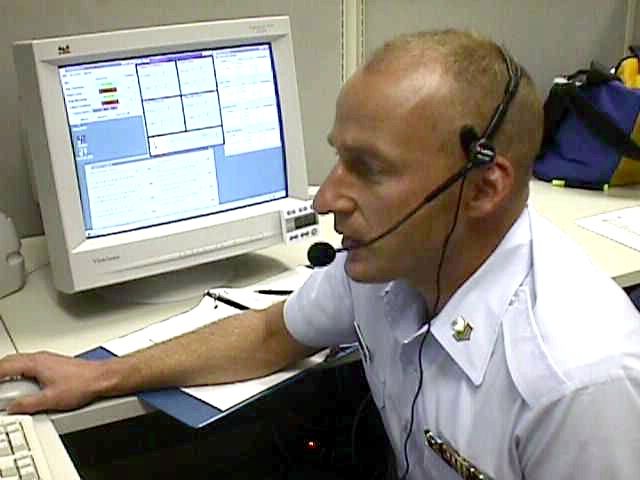
SAN DIEGO, Ca (July 12)--Watchstanders from Coast Guard
Activities San Diego test new equipment from NDRSMP at SPAWAR in
San Diego. The watchstanders were working a simulated case
with Coast Guard Auxiliary vessels underway and making
transmissions. USCG photo by PA1 Jamie Devitt-Chacon.
|
|
|
|